
Bedroom floor
The most obvious dust
Most dust collected
No association was observed between bedroom-floor dust weight and asthma or wheeze.
“Your mattress is probably the dirtiest part of your home.”1 — Dr Chin Chao-Wu David Otorhinolaryngologist


I want to be upfront about something before we get into this.
I am not someone who worries about this kind of thing. I'm not a germaphobe. I don't read ingredient labels. I change my sheets weekly and I consider that sufficient, and until about three weeks ago I had never once thought seriously about what was happening inside my mattress.
Then I changed my sheets and noticed a smell.
Not a strong smell. Nothing obviously wrong. Just a faint, slightly stale warmth coming off the mattress underneath — the kind of smell you notice, dismiss, and then find yourself thinking about later when you're trying to sleep.
So I did what any reasonable person does at eleven o'clock at night when something is bothering them.
I googled it.
Three hours later I was still reading, and I was considerably less comfortable than when I started. Because it turns out the average mattress — used, slept-in, changed-sheets-every-week mattress — can accumulate allergen levels that researchers describe as clinically significant. High enough, in sensitised individuals, to trigger symptoms. Not sometimes. Routinely.
I found that hard to believe at first. So I kept reading.
What I found — about what actually collects inside a mattress over time, about why the usual approaches don't touch it, and about whether there's anything that actually works — is what this article is about.
I'll warn you now: you may not look at your bed the same way afterwards.

The finding
Researchers analysed dust vacuumed from nearly 7,000 ordinary U.S. bedrooms. Almost three-quarters contained between three and six detectable allergens, while more than 99% contained at least one.3a
In a separate national survey of 831 U.S. homes, 45.8% had at least three allergens at increased levels somewhere in the home.3b
That 831-home survey found the following allergens in dust samples taken from beds:
Percentages overlap because a single bed or home could contain several of the allergens tested.
Allergens weren't the only thing the research flagged.
The same surveys detected endotoxin in household dust — fragments of bacterial cell wall that accumulate wherever organic matter collects. Mattresses, being warm, rarely cleaned, and slept on for eight hours a night, are close to ideal conditions for this kind of buildup.
That finding sat with me.
So I went back through the research — national surveys, clinical studies, published reviews — trying to understand not just what accumulates in a mattress over time, but why it keeps accumulating. Why, despite the fact that most people consider themselves reasonably clean, the numbers stay this high across virtually every home tested.
Three things kept coming up. Three reasons why the problem persists even in households that are doing everything they think they're supposed to do.
I'll go through each one.
Discovery #3 is the one I'd pay closest attention to.
It's the reason I changed what I do — and it has nothing to do with cleaning more often.

The surprise
In a national survey of 829 U.S. households, researchers collected settled dust from five locations. The bedroom floor held the most dust—yet its dust weight showed no association with asthma or wheeze.4
Bedroom floor
Most dust collected
No association was observed between bedroom-floor dust weight and asthma or wheeze.
Bedroom bed
higher odds of current asthma
higher odds of wheeze
Upholstered furniture
higher odds of wheeze
These figures describe statistical associations after adjustment for several measured factors. They do not prove that dust directly caused asthma or wheeze.
Floors show dirt.
Beds and sofas hide it.
Vacuuming the floor is only part of the job.

Protection vs. cleaning
“But I already use a mattress protector.”
Good—keep using it. A protector can help guard against spills, stains and new debris. But protection and cleaning are different jobs.
The research
Specialist encasements zip around the mattress and are different from ordinary top protectors. In a randomized trial involving 1,122 adults, allergen-impermeable bedding covers produced lower mattress dust-mite allergen levels after six months. By twelve months, the difference from the control group was no longer statistically significant.5
≈66% lower
Mattress dust-mite allergen level compared with the control group.
No significant difference
The difference between the encasement and control groups was no longer statistically significant.
The trial found no significant improvement in its main clinical asthma outcomes from impermeable covers used as a standalone intervention.

Three approaches
Most dust-mite solutions do one of two things: kill mites or place a barrier between the mattress and the sleeper. Physical removal serves a different purpose.
Approach one
Mites may die, but allergenic waste and body fragments can remain in the mattress.
Approach two
Covers can reduce contact with material inside the mattress, but nothing is physically taken out.
Approach three
Vacuuming physically collects loose dust and some of the material carried within it.7
The research
85.1%
less dust-mite allergen
77.7%
less total dust
71.0%
less bacterial endotoxin
75.7%
less fungal β-glucan
This was a small study involving daily vacuuming. It does not establish what occasional use would achieve, and it did not test whether these reductions improved health symptoms.7
The question changed
“How do I kill them?”
“How do I get them out?”
The obvious question
Limitation one
A bulky body and wide floor head can be awkward around mattress quilting, seams and edges.
Limitation two
Many people would rather not use a tool that has just crossed their carpet directly on their bed.
Limitation three
Not every household vacuum uses a sealed, high-efficiency filtration system.
The three-job process
Agitate loose material settled against the fabric.
Draw loosened material away from the mattress surface.
Keep the collected material inside the machine.
Suction is only one part of the process. The machine also needs to loosen what has settled and contain what it collects.
So we kept looking
MEET THE PUROVANE M1

WHY WE CHOSE THESE FEATURES
The Purovane M1 is our purpose-focused vacuum for mattresses, sofas and other upholstered surfaces. Its features were selected around three essential jobs: loosening settled material, lifting it from the fabric and containing it inside the machine.
A motorized roller provides a 27,000 RPM tapping action across the fabric.
18 kPa suction draws loosened material into the collection chamber.
A HEPA filter and metal mesh create a dual-filtration pathway inside the machine.
Product features and specifications supplied by Purovane.
Customer experiences
Three experiences from mattresses, beds and sofas.

“I’m ashamed to admit that my mattress was gross. It didn’t look or smell dirty, but after using this vacuum and seeing what came off it… ugh!”

“I’ve used other mattress vacuums and always found the suction too weak. After one pass with this, I couldn’t believe how much dust it collected.”

“As a mum with two kids and two dogs, this has been a lifesaver. I use it on our mattresses, the kids’ beds, the dogs’ beds and the sofa.”
Loosen. Lift. Contain.
The studies measured what comes out of a mattress in a lab. The M1 lets you measure it in your own bedroom. With your own eyes.
Made for beds and sofas
Loosen, lifts, extracts
Physically extracts dust, hair, skin cells and the allergens they carry
90-Day money back Guarantee
Free and fast delivery

What to expect
You won't notice everything on night one. Here's how it actually tends to go.
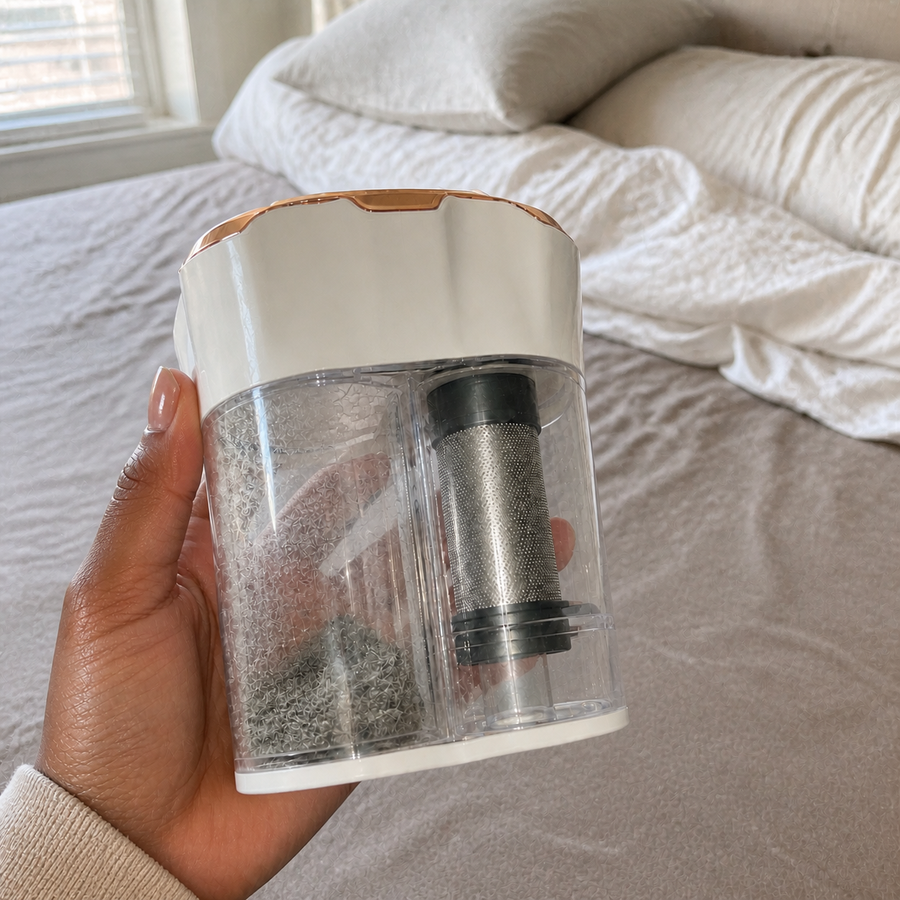
Run it slowly over the mattress you've slept on for years. Most people stop halfway through to look at the canister — that fine grey dust is skin, fibre and mite debris that a normal vacuum was never going to lift.
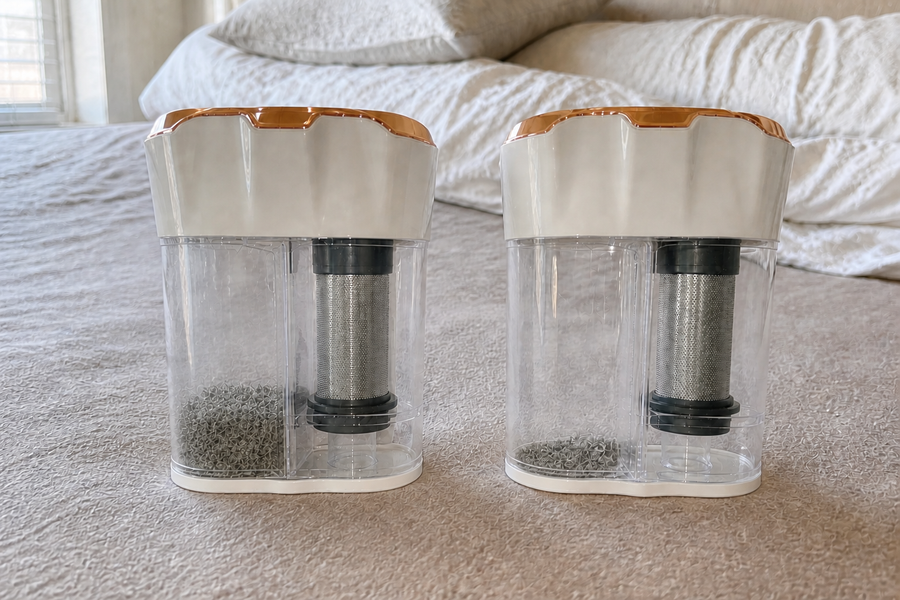
This is the pass that matters. Do exactly what you did last week and with a picture of your first canister, put the two canisters side by side. Less coming up means the first pass wasn't a one-off — it means it's out.
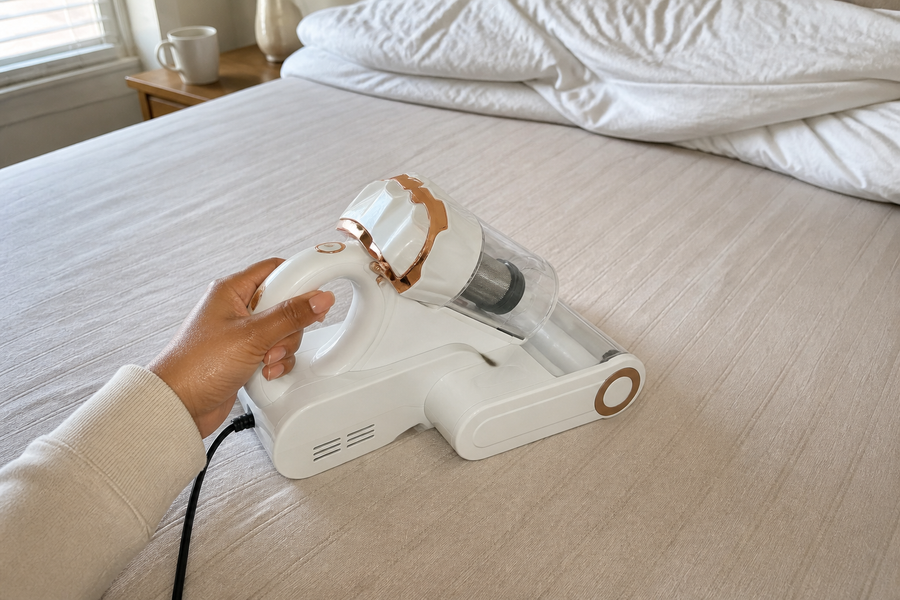
Once a week, sheets off, quick pass, sheets on. The canister stays light. Your bed stops being the thing you never think about cleaning.
Individual experience varies. This is a general guide to typical use, not a medical claim.
Before you order
We've got awnsers
It's a handheld, about the size of a shoebox and 1.4 kg. You lift the sheet off, run it over the mattress, and put the sheet back. Nothing to assemble and nothing to store beyond a shelf.
A household vacuum is tuned for hard floors and carpet pile, with a wide head that skips over a soft, uneven surface. This is tuned for fabric — the head stays sealed against the mattress and the suction pulls from inside the fibres rather than skating across the top.
The PuroVane M1 comes with 4 free aromatherapy pouches to makes sure you bed smells great after cleaning
Once a week is plenty for most people. The first pass takes longer because there's more to lift; after that it's about ten minutes for a double bed.
The lamp only switches on when the head is flat against a surface, so it cannot shine outward while you're using it. Keep it out of reach when it's not in use, as you would any appliance.
Send it back within 90 days for a full refund. You don't need to explain yourself and you don't need the original packaging.
3 to 8 days depending on location
Still on the fence? You have 90 days to change your mind.
CHECK AVAILABILTYA final note
Clean sheets make a bed feel fresh. But after looking into what can collect beneath them, I couldn’t ignore the mattress itself anymore.
That’s why the Purovane M1 exists—to help lift settled dust and debris from mattresses, sofas and other upholstered surfaces. It’s the focused job an ordinary floor vacuum simply wasn’t designed for.
I won’t pretend that one machine changes everything. But run it over a bed you would have called clean, then look inside the collection cup. For me, that was the part I couldn’t argue with.
I’ll be honest: I’m a bit of a neat freak. After using the Purovane M1 myself, what stayed with me wasn’t only what I saw inside the collection cup. It was the relief of knowing I’d finally given the bed I sleep in every night a proper, focused clean.
 Kindest regards,
Lucy Moss
Writing for Purovane
Kindest regards,
Lucy Moss
Writing for Purovane
© 2026 Purovane. All Rights Reserved.
────────────────────────────────────────────────
ABOUT THIS PAGE
This is an advertisement feature published and paid for by
Purovane. It is written to promote the Purovane M1 and is not
independent editorial content or impartial journalism.
RESEARCH AND SOURCES
The studies referenced on this page examined household dust,
allergens and their statistical association with respiratory
symptoms. They did not test the Purovane M1 or any other
mattress vacuum, and none of them assessed this product.
Findings described as "associations" are exactly that:
correlations observed across groups of households after
statistical adjustment. They do not establish that dust
directly causes asthma, wheeze or any other condition.
The researchers, authors, institutions and publications cited
on this page have no connection with Purovane. They have not
reviewed, approved or endorsed this product, this page or any
claim made on it. Quotations are reproduced with attribution
and a link to the original source, and refer to mattresses and
household dust in general — not to the Purovane M1.
HEALTH
Nothing on this page is medical advice, and the Purovane M1 is
not a medical device. It is a vacuum cleaner designed to remove
dust and debris from mattresses and upholstery. It is not
intended to diagnose, treat, cure or prevent any disease or
condition. If you have asthma, allergies or another health
concern, speak to a doctor or a qualified healthcare
professional.
WHAT TO EXPECT
How much material comes out of any given mattress depends on
its age, condition, use and how often it has been cleaned
before. Individual experience varies.
REFERENCES
3a. Salo PM, Wilkerson J, Rose KM, et al. “Bedroom allergen exposures in US households.” Journal of Allergy and Clinical Immunology. 2018;141(5):1870–1879.e14.
https://doi.org/10.1016/j.jaci.2017.08.033
3b. Salo PM, Arbes SJ Jr, Crockett PW, Thorne PS, Cohn RD, Zeldin DC. “Exposure to multiple indoor allergens in US homes and its relationship to asthma.” Journal of Allergy and Clinical Immunology. 2008;121(3):678–684.e2.
https://doi.org/10.1016/j.jaci.2007.12.1164
3c. Arbes SJ Jr, Cohn RD, Yin M, et al. “House dust mite allergen in US beds: Results from the First National Survey of Lead and Allergens in Housing.” Journal of Allergy and Clinical Immunology. 2003;111(2):408–414.
https://doi.org/10.1067/mai.2003.16
4. Elliott L, Arbes SJ Jr, Harvey ES, et al. “Dust weight and asthma prevalence in the National Survey of Lead and Allergens in Housing.” Environmental Health Perspectives. 2007;115(2):215–220.
https://doi.org/10.1289/ehp.9412
5. Woodcock A, Forster L, Matthews E, et al. “Control of exposure to mite allergen and allergen-impermeable bed covers for adults with asthma.” New England Journal of Medicine. 2003;349(3):225–236.
https://doi.org/10.1056/NEJMoa023175
6. Portnoy J, Miller JD, Williams PB, et al. “Environmental assessment and exposure control of dust mites: A practice parameter.” Annals of Allergy, Asthma & Immunology. 2013;111(6):465–507.
https://doi.org/10.1016/j.anai.2013.09.018
7. Wu FF, Wu MW, Pierse N, Crane J, Siebers R. “Daily vacuuming of mattresses significantly reduces house dust mite allergens, bacterial endotoxin, and fungal β-glucan.” Journal of Asthma. 2012;49(2):139–143.
https://doi.org/10.3109/02770903.2011.654023
Purovane ·
11 Bellmeadow, Maidstone, ME15 9NB, United Kingdom ·
support@purovane.com
Terms · Privacy Policy · Refund Policy · Shipping
────────────────────────────────────────────────